
High-Performance Insulation for Passenger Walkways
A reliable insulation solution to improve thermal performance and passenger comfort throughout its connecting walkways.
Located approximately 30 minutes from central Dunedin, Dunedin Airport is a key aviation facility serving passengers and communities across Otago and Southland. As a busy operational environment, maintaining comfortable and well-performing passenger areas is an important consideration, particularly through the colder months.
For this project, NZ Foam insulation was installed throughout the passenger walkways connecting the airport’s buildings. These areas presented a unique insulation challenge, with the need to reduce the impact of cold temperatures and minimise heat loss while working around complex surfaces and difficult-to-insulate areas. A reliable insulation system was required to provide consistent thermal performance without leaving gaps or cold spots.
NZ Foam’s closed-cell spray foam provided a practical solution, expanding into voids and irregular areas while bonding directly to the existing surfaces. The system created a continuous thermal and air-sealing barrier throughout the walkways. The result was improved thermal performance and greater passenger comfort, demonstrating how NZ Foam insulation can provide a high-performance solution for demanding commercial and specialist environments.
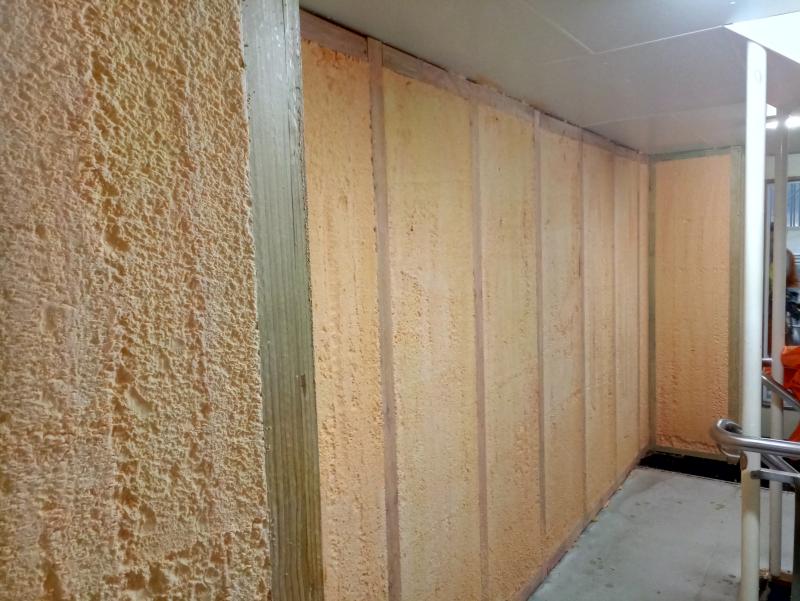
R3.1 NZ Foam Wall Insulation
Questions about this project
This project involved Dunedin Airport, an important aviation facility serving Dunedin and the wider Otago and Southland regions. The NZ Foam insulation was used in the passenger walkways connecting building-to-building areas, where maintaining passenger comfort was an important consideration.
The primary goal was to reduce the impact of cold temperatures in the walkways and create a more comfortable environment for passengers moving between buildings. The insulation needed to provide reliable thermal performance and help minimise heat loss through the building envelope.
NZ Foam was selected because its closed-cell spray foam can create a continuous layer of insulation, filling gaps and difficult areas while adhering directly to the substrate. This makes it particularly suitable for commercial and specialist projects where consistent thermal performance and air sealing are important.
NZ Foam insulation was installed along the walkways connecting the buildings, helping prevent passengers from experiencing the cold while travelling between different parts of the airport. The application provided a continuous insulated barrier rather than relying solely on separate pieces of conventional insulation.
The project achieved an insulation thickness of 70 mm, delivering an R-value of approximately R3.1.
A key advantage was the ability of spray foam to create a more continuous insulation and air-sealing layer. Unlike insulation products that require individual pieces to be accurately cut and fitted, spray foam expands into gaps, voids and irregular areas and bonds to the surface. NZ Foam states that this can help reduce draughts, uncontrolled airflow and cold spots while maintaining long-term performance.
The main challenge was creating effective insulation in a building environment where passenger comfort was important and the connecting walkways were exposed to cold conditions. NZ Foam’s spray-applied system allowed the insulation to conform to the available spaces and create a continuous thermal barrier. Its ability to adhere to different substrates and insulate complex shapes is one of the reasons NZ Foam promotes the product for specialist and commercial applications.
The project demonstrates that insulation should be considered as part of the overall building-performance strategy, rather than simply choosing a product based on thickness. For areas where cold temperatures, gaps, difficult access or irregular surfaces are concerns, a continuous spray-foam system can provide both insulation and air sealing. The key lesson is to select the insulation system according to the building’s specific performance requirements and have the required R-value and installation method properly specified.